
Wire Maze Electricity DIY STEM Kit
$8.99$4.95
Posted on: Aug 18, 2005
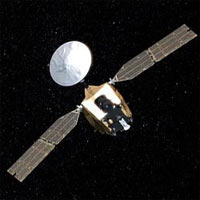
NASA's Mars Reconnaissance Orbiter, launched on Aug. 12, has completed one of the first tasks of its seven-month cruise to Mars, a calibration activity for the spacecraft's Mars Color Imager instrument.
'We have transitioned from launch mode to cruise mode, and the spacecraft continues to perform extremely well,' said Dan Johnston, Mars Reconnaissance Orbiter deputy mission manager at NASA's Jet Propulsion Laboratory, Pasadena, Calif.
The first and largest of four trajectory correction maneuvers scheduled before the orbiter reaches Mars is planned for Aug. 27.
For the calibration task on Aug. 15, the spacecraft slewed about 15 degrees to scan the camera across the positions of the Earth and Moon, then returned to the attitude it will hold for most of the cruise. Data were properly recorded onboard, downlinked to Earth and received by the Mars Color Imager team at Malin Space Science Systems, San Diego. Dr. Michael Malin of Malin Space Science Systems, principal investigator for Mars Color Imager, said the image data are being processed and analyzed.
This multiple-waveband camera is the widest-angle instrument of four cameras on the orbiter, designed for imaging all of Mars daily from an altitude of about 300 kilometers (186 miles). Imaged at a range of more than 1 million kilometers (620,000 miles) away, the crescent Earth and Moon fill only a few pixels and are not resolved in the image. However, this is enough useful information to characterize the instrument's response in its seven color bands, including two ultraviolet channels that will be used to trace ozone in the Mars atmosphere.? This is the first of two events early in the cruise phase that check instrument calibrations after launching. The second will occur in early September when higher resolution cameras are pointed at Earth and the Moon as the spacecraft continues its flight to Mars.
The Mars Reconnaissance Orbiter will reach Mars and enter orbit on about March 10, 2006. After gradually adjusting the shape of its orbit for half a year, it will begin its primary science phase in November 2006. The mission will examine Mars in unprecedented detail from low orbit, returning several times more data than all previous Mars missions combined. Scientists will use its instruments to gain a better understanding of the history and current distribution of Mars' water. By inspecting possible landing sites and by providing a high-data-rate relay, it will also support future missions that land on Mars.