
Battery-Powered Balancing Robot DIY STEM Kit
$8.99$4.95
Posted on: May 9, 2004
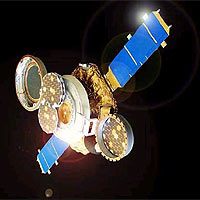
Image courtesy: NASA
NASA's Genesis spacecraft flew past Earth on Saturday (May 1st) in a loop that puts it on track for home - and a dramatic mid-air recovery Sept. 8.
The Genesis mission was launched in August of 2001 to capture samples from the storehouse of 99-percent of all the material in our solar system - the Sun. The samples of solar wind particles, collected on ultra-pure wafers of gold, sapphire, silicon and diamond, will be returned for analysis by Earth-bound scientists. The samples Genesis will provide will supply scientists with vital information on the composition of the Sun, and will shed light on the origins of our solar system.
"Genesis has been way out there collecting samples from space for a long time," said Genesis project manager Don Sweetnam of NASA's Jet Propulsion Laboratory, Pasadena, Calif. "Saturday, we brushed past Earth just beyond the Moon's orbit. On September 6, we will again approach Earth at lunar distance, but this time we are going to come on in carrying NASA's first samples from space since Apollo 17 carried the last moon rocks back in December of 1972."
The Earth flyby occurred at about 3:00 a.m. Pacific Daylight Time on Saturday, May 1, at an altitude of 386,000 kilometers (239,850 miles) above the planet's surface - just beyond the Moon's orbit. At that time, the spacecraft was traveling at a speed relative to Earth of 1.26 kilometers per second (2,800 miles per hour).
Helicopter flight crews, navigators and mission engineers are preparing for the return of the spacecraft. The will dispatch a sample return capsule that will re-enter Earth's atmosphere for a planned mid-air capture at the U.S. Air Force Utah Test and Training Range on Sept. 8. To preserve the delicate particles of the Sun, specially trained helicopter pilots will snag the return capsule from mid-air using custom-designed hooks. The flight crews for the two helicopters assigned for Genesis capture and return are comprised of former military aviators and Hollywood stunt pilots.