


Doodling Shake Bot DIY STEM Kit
$8.99$4.95
Posted on: Mar 10, 2003
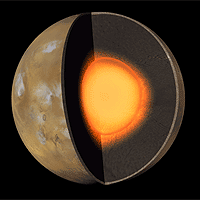
New information about what is inside Mars shows the red planet has a molten liquid iron core, confirming the interior of the planet has some similarity to Earth and Venus.
Researchers at NASA's Jet Propulsion Laboratory, Pasadena, Calif., analyzing three years of radio tracking data from the Mars Global Surveyor spacecraft, concluded that Mars has not cooled to a completely solid iron core, rather its interior is made up of either a completely liquid iron core or a liquid outer core with a solid inner core. Their results are published in the March 7, 2003 online issue of the journal Science.
"Earth has an outer liquid iron core and solid inner core. This may be the case for Mars as well," said Dr. Charles Yoder, a planetary scientist at JPL and lead author on the paper. "Mars is influenced by the gravitational pull of the Sun. This causes a solid body tide with a bulge toward and away from the Sun (similar in concept to the tides on Earth). However, for Mars this bulge is much smaller, less than 1 centimeter (0.4 inch). By measuring this bulge in the Mars gravity field we can determine how flexible Mars is. The size of the measured tide is large enough to indicate the core of Mars can not be solid iron but must be at least partially liquid."
The team used Doppler tracking of a radio signal emitted by the Global Surveyor spacecraft to determine the precise orbit of the spacecraft around Mars. "The tidal bulge is a very small but detectable force on the spacecraft. It causes a drift in the tilt of the spacecraft's orbit around Mars of one-thousandth of a degree over a month," said Dr. Alex Konopliv, a planetary scientist at JPL and co-author on the paper.
The researchers combined information from Mars Pathfinder on the Mars precession with the Global Surveyor tidal detection to draw conclusions about the Mars core, according to Dr. Bill Folkner of JPL, another co-author of the paper.
The precession is the slow motion of the spin pole of Mars as it moves along a cone in space (similar to a spinning top). For Mars, it takes 170,000 years to complete one revolution. The precession rate indicates how much the mass of Mars is concentrated toward the center. A faster precession rate indicates a larger dense core, compared to a slower precession rate.
In addition to detection of a liquid core for Mars, the results indicate the size of the core is about one-half the size of the planet, as is the case for Earth and Venus, and that the core has a significant fraction of a lighter element such as sulfur.
In addition to measuring the Mars tide, Global Surveyor has been able to estimate the amount of ice sublimated, changed directly into a gaseous state, from one pole into the atmosphere and then accreted onto the opposite pole. "Our results indicate the mass change for the southern carbon dioxide ice cap is 30 to 40 percent larger than the northern ice cap, which agrees well with the predictions of the global atmosphere models of Mars," said Yoder.
The amount of total mass change depends on assumptions about the shape of the sublimated portion of the cap. The largest mass exchange occurs if we assume the cap change is uniform or flat over the entire cap, while the lowest mass exchange corresponds to a conically shaped cap change.