You are here
Go to Education Section
Go to Reference Section
Go to Directories Section
Go to Community Section
Go to Fun Section
Go to Science Store
Go to About PhysLink.com
Top Destinations Menu
 Ask the ExpertsAsk the
Experts

 Physics Job BoardPhysics
Job Board

 Physics and Astronomy Departments DirectoryUniversity
Departments

 FREE Einstein eCardsEinstein
eGreetings

 PhysLink.com Science eStoreScience
eStore


Need an interior designer in the Los Angeles area? Visit: Odeau.com


Physics & Astronomy News
Suspected Asteroid Crash Leaves Odd Debris Trail
Source: JPL/NASA   Posted: 2/8/2010
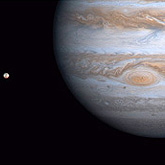
NASA's Hubble Space Telescope has observed a mysterious X-shaped debris pattern and trailing streamers of dust that suggest a head-on collision between two asteroids.
Full story...
Glitter-sized solar photovoltaics produce competitive results
Source: Sandia   Posted: 2/8/2010
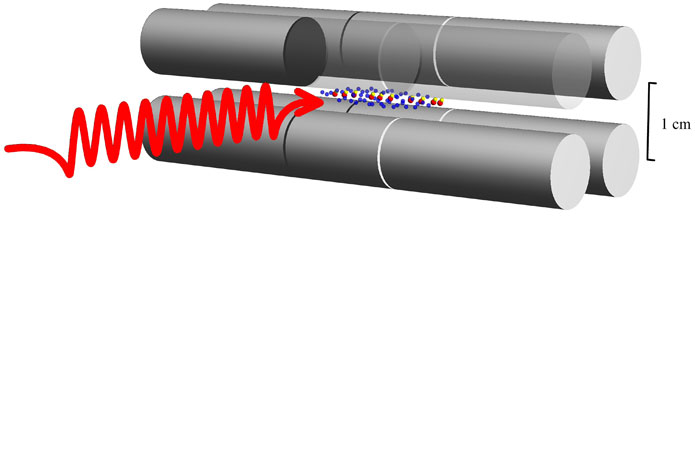
Scientists have developed tiny glitter-sized photovoltaic cells that could revolutionize the way solar energy is collected and used.
Full story...
New Hubble Maps of Pluto Show Surface Changes
Source: NASA   Posted: 2/8/2010
NASA released the most detailed set of images ever taken of the distant dwarf planet Pluto. Pluto has become significantly redder, while its illuminated northern hemisphere is getting brighter.
Full story...
Learning from toys
Source: Harvard   Posted: 2/8/2010
Researchers gauge how entropy works by creating models.
Full story...
click here for more physics news
Pluto: Beyond Neptune Or Not?

by Gene Mascoli and ScienceIQ.com

Artist Rendition of Pluto, its moon Charon and spacecraft.


Image Courtesy NSSDC

Did I catch you? Pluto (newly classified as a dwarf-planet) comes after planet Neptune. Right? Depends. Pluto takes 248 years to orbit the Sun. Most of that time Pluto's orbit puts it outside the orbit of Neptune. But, for 20 years out of each orbit cycle, Pluto's orbit brings it closer to the Sun than Neptune. Most recently, Pluto was in 8th place from February, 1979 until February, 1999. Now, it's back beyond Neptune, and will stay there for the next 200 years.

Pluto is the only ex-planet (now a dwarf-planet) in our solar system to have this orbital characteristic. This is caused by its very elongated orbital path. Most planets travel around the Sun in an elliptical orbit that is closer in shape to a circle. They pretty much remain the same distance from the Sun during their annual trip. This is true of Neptune. But Pluto's orbital distance from the Sun varies by over 1.86 billion miles (about 3 billion km), enough to cause its orbital anomaly.

Don't worry about Pluto colliding with Neptune though. Pluto's different in that respect as well. Rather than orbiting on a relatively flat plane as the other planets do, Pluto's orbit brings it above and over the orbit of Neptune. Their paths don't cross.

For more science facts like this one go to: ScienceIQ.com


Quick Poll
Will you visit PhysLink.com again in the future?
No answer
Yes, definitely
Maybe
No, never again
 
J. Robert Oppenheimer'There must be no barriers for freedom of inquiry. There is no place for dogma in science. The scientist is free, and must be free to ask any question, to doubt any assertion, to seek for any evidence, to correct any errors.'

J. Robert Oppenheimer
(1904-1966)

Xump.com Science Store
Grade Master Electronic Grading Pen
Grade Master Electronic Grading PenReduce grading errors and save time with this easy to use grading pen!

$34.99 $29.95 /each
View details

Crinoide Fossil Plate
Crinoide Fossil PlateAn superb fossil specimen for the science classroom or the avid fossil collector!

$29.99 $29.95 /each
View details

Human Eye Model
Human Eye ModelIn the blink of an eye watch learning come to life!!

$59.99 $39.95 /each
View details

Prepared Slide Set - High School
Prepared Slide Set - High SchoolGreat high-school set of 25 prepared microscope slides. Lungs, spinal cord, arteries, and more.

$49.99 $34.95 /each
View details

The Young Scientist Series - Set 10
The Young Scientist Series - Set 10This set includes: Seeds, Fruits, and other Plant Parts (Kit 28), Eggs (Kit 29) & Owls (Kit 30).

$24.99 $22.95 /each
View details

Creative Cosmetics Science Kit
Creative Cosmetics Science KitThe Science of Skin Care: Experience the beautiful side of biology and chemistry with this unique collection of experiments.

$79.99 $49.95 /each
View details

Click here to view other physics & astronomy related products from our online store.


go to the top  


All rights reserved. © Copyright '1995-'2010 PhysLink.com